
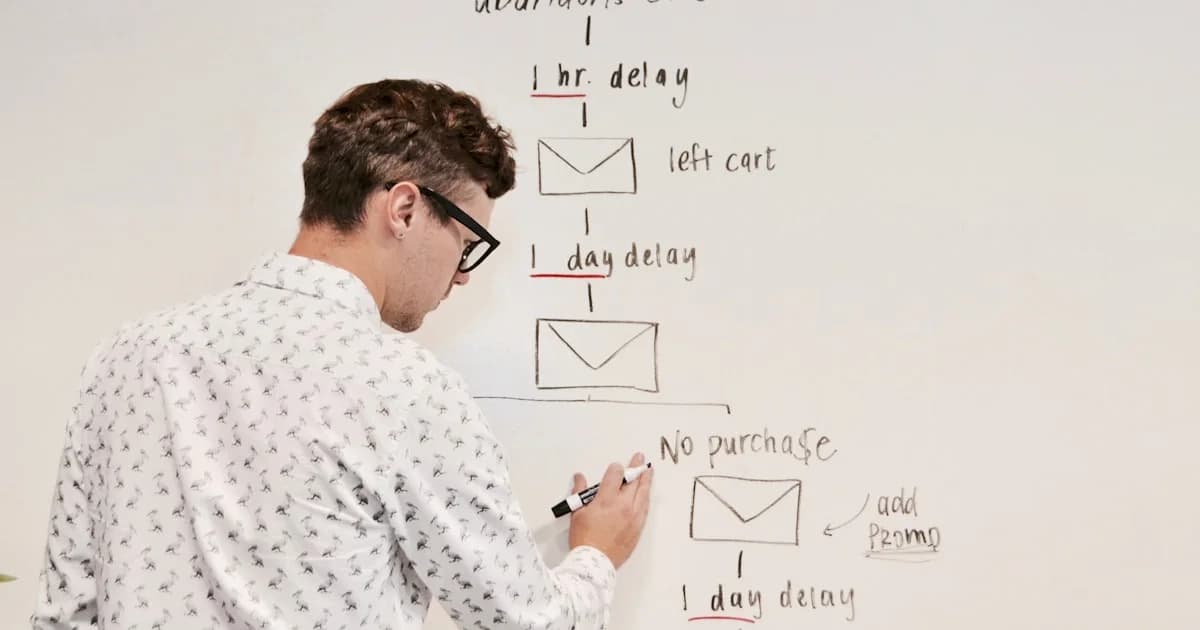

Yes, AI can help turn a photographed whiteboard into candidate tasks, owners and dates. The result needs attendee confirmation before anyone receives an assignment. A useful workflow preserves the original wording, shows where it appeared, and separates agreed actions from unreadable notes, open questions and possible duplicates.
The practical goal is a reviewed meeting-action list that people recognise as their agreement. A neat transcription alone cannot establish who accepted responsibility or whether a scribbled date was a deadline.
Capture the board so people can check the result
Before erasing the board, take a straight-on photograph showing the whole discussion. Check that headings, arrows and the edges are visible. If small writing needs close-ups, keep the whole-board image too: a crop can lose the heading that explains which project a note belongs to.
Record the meeting name, meeting date and attendees separately. Do not treat the photograph's upload date as the meeting date. These details help resolve phrases such as “Friday” and initials such as “TM”, but they are context for review, not permission to guess.
Give each photo a simple reference, such as “planning-board-main” or “planning-board-right”. Describe locations in everyday language: “top-right under Dispatch”. Reviewers should be able to find the relevant writing without searching the entire image.
Where a board contains unrelated sensitive information, prepare an appropriate version for the review audience. Keep enough surrounding context to interpret the action correctly. Decide who may receive the photograph before circulating it with the list.
Extract evidence before rewriting it as work
Use two passes. First, capture visible wording and relationships: headings, bullets, arrows, crossed-out text and names. Second, propose which entries represent actions. Keep the transcription beside the rewritten task so changes in meaning remain visible.
Microsoft documents printed and handwritten text extraction through Azure Document Intelligence's Read model, and text and document structure extraction through Layout. That provides a possible extraction component; it does not establish reliable interpretation of your team's particular whiteboard. Source: Azure Document Intelligence overview
Distinguish an action from a topic. “Supplier delays” is a discussion heading. “Ask supplier for revised delivery date” is a candidate action. “Could we change supplier?” remains a question unless attendees confirm that someone agreed to investigate it.
Preserve visible uncertainty. If the photograph reads “update [unreadable] list”, do not turn it into “update customer list” because that sounds plausible. Ask what the missing word was. Likewise, keep crossed-out entries out of the creation queue until their status is clear.
Make each candidate assignment recognisable
A proposed task should describe a concrete next step without adding an outcome the meeting never agreed. “Contact courier about delivery slot” should not become “Resolve all delivery problems”. Preserve project names and familiar terminology where they help attendees recognise the work.
Keep the owner as written separately from the confirmed owner. Initials may match several people; a department name may describe a team rather than an individual. Use the attendee list to suggest a question, not silently select an account.
Dates need the same care. Keep “Fri” as the source wording, then ask for the full date. For “06/11”, confirm the intended day, month and year. If no deadline was agreed, allow an explicit “no deadline agreed” decision rather than inventing urgency.
A consistent record can contain source wording, proposed action, owner, date, board location, unresolved question and review status. OpenAI's Structured Outputs documentation describes constraining responses to a supplied schema. A consistent structure helps organise review; it does not prove that an extracted name, date or task is correct. Source: OpenAI Structured Outputs
For background on tailoring this interpretation, see what a custom AI agent means. The field rules still need to come from your meeting process.
Use this meeting-action review checklist
Copy the following into your meeting notes. Its gates are proposed operating rules for this workflow.
Meeting-action review checklist
Meeting: ______ Meeting date: ______ Attendees: ______ Photo references: ______ Review coordinator: ______
For every candidate action, complete:
- Reference and location: Identify the photo and board area.
- Original wording: Copy readable text; mark unreadable words explicitly.
- Proposed task: Describe the next step without adding commitments.
- Owner evidence: Record the written name or initials; obtain the confirmed person's name.
- Date evidence: Record the written date; confirm a full date or “no deadline agreed”.
- Open question: State exactly what remains unclear.
- Duplicate check: Compare overlapping photos and existing tasks; record any match.
- Attendee decision: Confirm, correct, hold or reject; record who responded.
- Creation approval: Record the approved wording, owner, date decision and approver.
- Creation result: Record the task link or failure; notify the owner only after successful creation.
Creation gate: Create only approved actions with a confirmed owner, an explicit date decision and a completed duplicate check. Hold unresolved rows. Recheck approval if the wording, owner or date changes.
Close-out: Keep rejected and merged rows visible in the meeting record. Send attendees the confirmed list and outstanding questions. Silence does not count as confirmation.
Work through ordinary, unclear and duplicate cases
Consider a hypothetical operations meeting held on 6 October 2026. The board says “Naledi , send revised delivery schedule , 9 Oct”. The proposed action is “Send the revised delivery schedule”, with Naledi as the candidate owner and 9 October 2026 as the candidate deadline.
The coordinator shows Naledi the source and asks her to confirm the assignment and date. She confirms both. After checking existing work for the same schedule, the coordinator approves creation. The expected result is one task containing the agreed wording and a reference back to the meeting record.
Now suppose the same board says “TM , check [unreadable] , Fri”. Two attendees share those initials. Hold the row and ask: “Who accepted this action, what needs checking, and which Friday was intended?” Do not create separate tasks for both people. If attendees cannot recover the agreement, retain it as unresolved and revisit it with the meeting organiser.
A missing-field case is different: “Send stock count to warehouse” is readable but has no owner or date. Ask attendees whether it was an agreed action. If so, obtain an owner and either a deadline or confirmation that none was agreed. Readable text does not make an assignment complete.
For duplicates, imagine the whole-board photo and a close-up both contain “Naledi , send revised delivery schedule”. Merge the candidates only after confirming they refer to the same action, retaining both source references. If an existing task covers that work, show it to Naledi. She decides whether to update it or whether the meeting introduced a distinct deliverable.
A final ambiguous case is an arrow from “Dispatch” towards “Thabo”, passing near several bullets. Ask which bullets the arrow covers. Its position is evidence to inspect, not enough to assign every nearby item to Thabo.
Put confirmation before task creation
Present the source crop beside the candidate action. Ask attendees to confirm their own assignments, while a coordinator resolves cross-team questions. A broad “Does this look fine?” invites overlooked details; ask specifically about the action, owner and date.
Task creation should be a separate step using the approved version. OpenAI's function-calling guide describes model tool calls as requests, with application-side code executing the action. Your integration must therefore enforce the creation gate; extraction alone does not create a reviewed task. Source: OpenAI function calling
If creation fails, retain the approved row and check the destination before retrying. A timeout may leave uncertainty about whether a task exists. Record successful task references so another photo upload or retry does not create the assignment again.
Before deployment, check current product, account, plan and region eligibility for the selected components. Trial the proposed process with representative boards and compare its list with attendee-confirmed actions. Look for omissions, invented actions, wrong owners and unresolved dates rather than judging only how polished the output looks.
FAQ: Whiteboard photos and meeting assignments
Can we create tasks directly from a clear photograph?
A clear photograph supports checking the writing, but does not confirm a commitment. Keep attendee confirmation in this workflow even when extraction looks accurate. Someone still needs to verify that the note represents agreed work.
What should happen when a name or date is unreadable?
Hold that candidate and show the relevant crop with a precise question. An attendee may supply a correction; record it as their confirmation. If nobody can resolve it, leave the field unresolved and create no assignment from that row.
Do we need a custom agent for every whiteboard meeting?
Start with the simplest process that supports extraction, review and controlled creation. Repeated terminology or interpretation rules may justify more tailoring. Compare AI agents and automation and the approach to custom AI agent workflows before choosing.
If your business needs help connecting board capture, attendee review and task creation, Workflow automation is a relevant starting point within AI automation. Bring a representative board and your existing assignment process when you get in touch.