
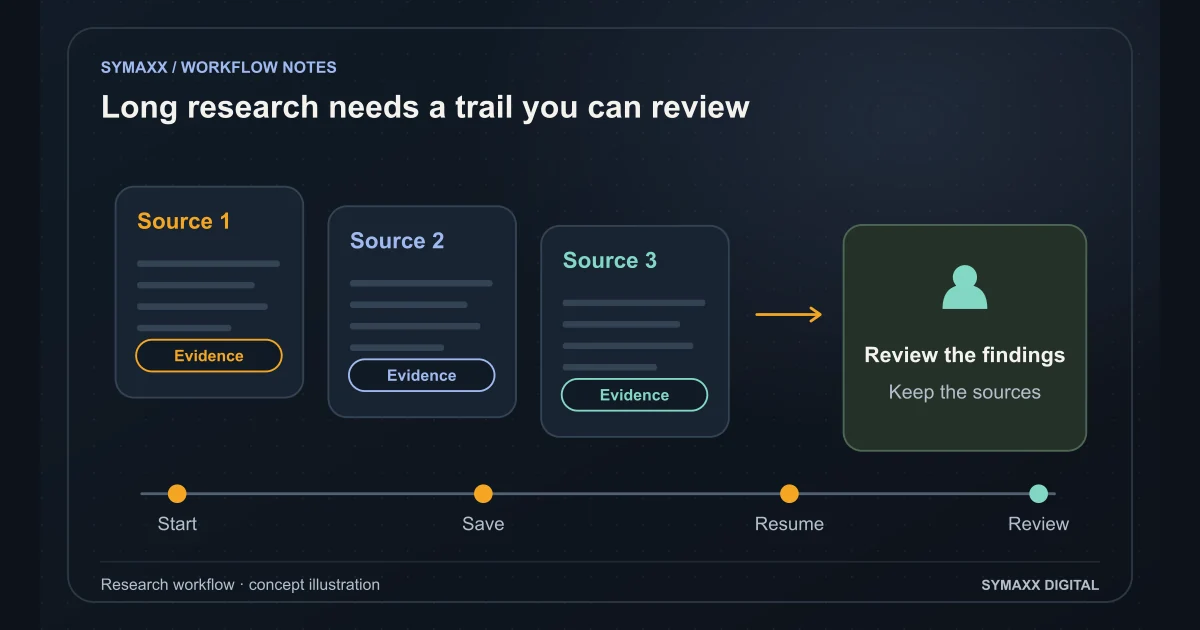

OpenAI’s Agents API helps when hours-long research needs repeated tool use, saved intermediate work and continuity that your team would otherwise have to build. It is worth considering for a bounded supplier due-diligence pilot, not because a long task automatically needs an agent. Choose it only if its runtime fits your evidence, recovery and data-control requirements. Keep supplier approval with people, and treat the public beta as a constraint to evaluate rather than a production guarantee.
1. Establish why the research takes hours
Use an agent when the research path changes as evidence arrives; use a simpler workflow when the steps are predictable.
A proposed supplier pilot might gather public company information, compare supplied documents, identify unanswered questions and prepare a review pack. The difficult part is not writing a summary. It is deciding what to investigate next while preserving the reason for each finding.
First separate active research from waiting. A job that waits for a supplier to email a document may need a queue and a reminder, not an agent running continuously. A job that follows conflicting company names across several documents may benefit from adaptive investigation.
Write the deliverable before selecting the runtime: “Prepare a source-linked evidence pack and unresolved-question list for procurement review.” Exclude supplier approval, bank-detail changes, payment release and legal conclusions.
For terminology, the custom AI agent glossary provides a starting point. The practical distinction is delegated research within defined permissions, not unrestricted decision-making.
2. Separate the managed harness from the sandbox
Choose orchestration and execution environment as separate decisions, because you can use a managed harness without choosing a provider-hosted sandbox.
OpenAI’s Source: 10 September 2026 announcement describes a public-beta managed harness, environment options including hosted and own infrastructure, long-session context management and parallel subagents. Those capabilities make the API relevant to extended research, but do not establish that this supplier workflow will work well.
Use this proposed decision table:
| Choice | Consider it when | Check before committing |
|---|---|---|
| Managed harness, hosted sandbox | A low-sensitivity pilot needs limited environment customisation | File persistence, access controls, network access and export behaviour |
| Managed harness, your environment | Research needs controlled internal connections or storage | Integration effort, credential boundaries and failure handling |
| Team-owned orchestration and environment | Exact scheduling, recovery or portability requirements dominate | Engineering capacity and ongoing maintenance |
| Fixed automation | Collection and extraction follow stable steps | Whether exceptions can simply enter a human queue |
The agents versus automation comparison can help frame the last choice. Owning the runtime means maintaining it, not merely hosting a server.
3. Bound the pilot before granting access
Start with restricted research permissions and explicit exclusions, rather than access to every procurement system.
For a hypothetical South African pilot, use a small set of supplier records containing public information and documents cleared for processing. A procurement owner should define the questions. A security reviewer should approve the data flow, and an appropriate legal or privacy adviser should assess any sensitive processing or cross-border implications.
Proposed permissions should allow reading approved documents, searching permitted sources and writing to a dedicated research folder. They should not allow changes to supplier master records or access to payment credentials.
Treat web pages and supplier files as evidence, never as instructions. A document telling the agent to upload records elsewhere must not alter its permissions. Enforce tool and destination restrictions in application code, not only in the research prompt.
The September announcement identifies public-beta availability. It does not settle South African hosting, residency or account-specific requirements. Confirm current account access, model and tool compatibility, environment availability and applicable terms before the pilot. Do not interpret silence about a regional control as confirmation that it exists.
4. Save evidence before producing conclusions
Store a durable evidence ledger as research proceeds, because a polished summary cannot substitute for retrievable supporting material.
Propose one record per finding, with these fields: supplier record ID, research question, source URL or document reference, source date where available, retrieval timestamp, relevant extract, interpretation, uncertainty, and evidence status. Use “not found” where appropriate rather than forcing a positive answer.
Keep source material separate from the agent’s interpretation. Label a supplier’s own statement as such. A website repeating another website is not necessarily independent corroboration. Record the underlying source when it can be identified.
OpenAI’s Source: Structured Outputs guide describes schema-constrained responses. That can support a consistent evidence-record format in a compatible extraction component; it does not prove the extracted facts are correct. Confirm compatibility rather than assuming the guide’s examples transfer directly into an Agents API session.
Validate records in your application. Reject unsupported statuses, flag absent source references and preserve incomplete or refused outputs. A missing value should create a review task, not become an invented registration number or document date.
5. Define checkpoints and restart boundaries
Resume from the last validated checkpoint, not from an assumption that the session remembers everything correctly.
Propose checkpoints after source collection, document extraction, entity matching and review-pack preparation. Each should record completed work, unresolved questions, evidence references, tool results and the next permitted action. Store it in a location whose persistence your team has verified.
Context continuity and business recovery are different requirements. Even if a session can continue, your application still needs to know whether a file write succeeded and whether a record is complete.
OpenAI’s Source: function-calling guide explains that application code executes model-requested functions, and points Agents API sessions towards registered functions and session action requests. Use that boundary to validate arguments and permissions before execution.
For proposed writes, assign a stable key based on the supplier, research question and evidence item. Before retrying, check whether that key already exists. Record uncertain write outcomes for reconciliation. If supplier identity changes, invalidate identity-dependent findings rather than appending a new name to the old pack.
6. Route exceptions by consequence
Escalate uncertainty according to what it could affect, rather than treating every missing field as either harmless or disqualifying.
Use proposed exception categories: missing evidence, conflicting evidence, possible duplicate entity, inaccessible source, tool failure and prohibited action request. Assign each category an owner and a permitted next step.
A missing brochure may leave a capability question unanswered. Conflicting legal names may require procurement to establish which entity is being assessed before research continues. Neither should trigger automatic supplier rejection.
For payment-related information, stop at documenting the discrepancy and handing it to the authorised payment-verification process. A research agent should not decide which bank account is genuine. Tax status, contractual meaning and security implications likewise need appropriate human judgement.
Allow independent questions to continue only where the unresolved issue cannot contaminate them. If entity identity is uncertain, researching adverse information under a similar name could attach another company’s history to the supplier. Pause that branch, preserve the sources and explain the uncertainty in the review pack.
The custom-agent workflow resource is useful for mapping these hand-offs before development.
7. Evaluate the runtime against a simpler option
Select the runtime on observable evidence quality, recovery and operating effort, not on how impressive the final prose looks.
Run the same approved brief through the proposed agent pilot and a simpler collection-and-review workflow. Use comparable source access and human-review requirements. Include straightforward suppliers, missing documents, conflicting names, repeated sources and an interrupted execution.
Measure whether reviewers can open the evidence, trace each claim and distinguish unknowns from supported findings. Record human correction time, unresolved identity problems, duplicate writes, recovery effort and total run cost. Separate elapsed time from active reviewer time.
Proposed acceptance gates are: no unauthorised actions, retrievable evidence for substantive claims, visible unresolved issues and a demonstrated restart without duplicate records. The business owner should approve any numerical targets before evaluation.
Public-beta changes also need regression checks. Preserve the brief, configuration and sample evidence pack so a changed model or runtime can be assessed against the same questions. Potential time savings remain a hypothesis until measured. A simpler workflow may be preferable if the managed option adds integration work without improving the reviewable output.
Reusable supplier research pilot checklist
Complete this proposed checklist before running the pilot. Blank fields are decisions still to make, not permission to let the agent choose.
- Decision: Prepare supplier evidence for human review; no approval, payment, tax or legal decision.
- Owner: Procurement reviewer ___; technical owner ___; security/privacy reviewer ___.
- Inputs: Supplier record IDs ___; approved documents ___; permitted public sources ___.
- Questions: Identity ___; capability claims ___; document gaps ___; conflicting information ___.
- Runtime: Managed or owned harness ___; sandbox ___; reason ___; beta limitations accepted ___.
- Permissions: Read locations ___; write folder ___; allowed tools ___; prohibited actions ___.
- Evidence record: Supplier ID, question, source reference, retrieval time, extract, interpretation, uncertainty and status.
- Checkpoints: Collection, extraction, identity matching and review pack; durable storage location ___.
- Restart: Verify prior writes; reuse stable evidence keys; resume unfinished work; invalidate findings affected by changed identity.
- Exceptions: Missing evidence to ___; conflicting identity to ___; tool failure to ___; sensitive-data concern to ___.
- Limits: Proposed time cap ___; spend cap ___; retry cap ___; expiry of evidence ___.
- Evaluation: Check traceability, correction effort, duplicate writes, recovery and total cost against the simpler workflow.
- Release gate: Human accepts evidence pack and unresolved-question list; operational decisions remain outside the pilot.
Worked walkthrough: normal and ambiguous suppliers
A normal case should produce a reviewable pack; an ambiguous case should produce a clear hold on affected research, not a confident guess.
In this hypothetical example, a team scopes three fictional suppliers and proposes a four-hour research cap. For Supplier A, the supplied company name and identifier agree across approved documents. The agent saves document references, extracts the relevant details and records where the supplier’s capability claims lack independent support. Procurement opens the references and decides whether further evidence is needed. Agreement across documents is not itself approval.
Supplier B has a trading name on its website and a different legal name on a supplied document. The agent records both, marks entity matching unresolved and pauses identity-dependent searches. Procurement asks the supplier to clarify the relationship and provide suitable evidence. Only after human confirmation does the technical owner authorise that branch to resume.
Supplier C has no current supporting document for a requested claim. Two search results repeat the same supplier statement. The expected output records the gap and shared source lineage, rather than counting those pages as separate confirmations.
If execution stops after Supplier A’s extraction checkpoint, the proposed restart reads that checkpoint and checks saved evidence keys. It resumes unfinished questions without recreating completed records. A failure to demonstrate this behaviour counts against the runtime choice.
FAQs about hours-long supplier research
Does a four-hour research job need a continuously running agent?
No. Four hours is a hypothetical duration, not a selection threshold. If most of that time is waiting for a document, a paused workflow with a human queue may be enough. Consider the Agents API when the active work requires changing research steps, using tools and preserving intermediate results. Evaluate those needs separately from the calendar time between starting and finishing.
Can the agent resume safely after a sandbox interruption?
Only after your team verifies persistence and recovery behaviour for the chosen environment. The proposed process saves checkpoints and evidence outside conversational memory, then reconciles uncertain writes before resuming. Test an interruption during collection and another around a write. If the team cannot establish what completed, send the case to a technical owner instead of allowing an unrestricted retry.
What should happen when supplier names conflict?
Pause identity-dependent research and ask procurement to establish the correct entity. Preserve both names, their sources and the reason for uncertainty. Do not merge records merely because names look similar, or treat a mismatch as proof of wrongdoing. Once a person resolves the identity, reassess any earlier findings that depended on it and record the correction in the evidence pack.
Take the runtime decision into a scoped brief
Choose a limited evidence-preparation pilot before committing to a wider deployment. The useful output is a reviewable supplier pack with reliable restart boundaries, not an autonomous procurement decision.
If your business needs help defining that boundary, Symaxx’s custom AI agents service offers a route to discuss the scope. For a broader workflow decision, explore AI automation. Get in touch with the checklist, a cleared sample document set and the exceptions your team needs to handle.