
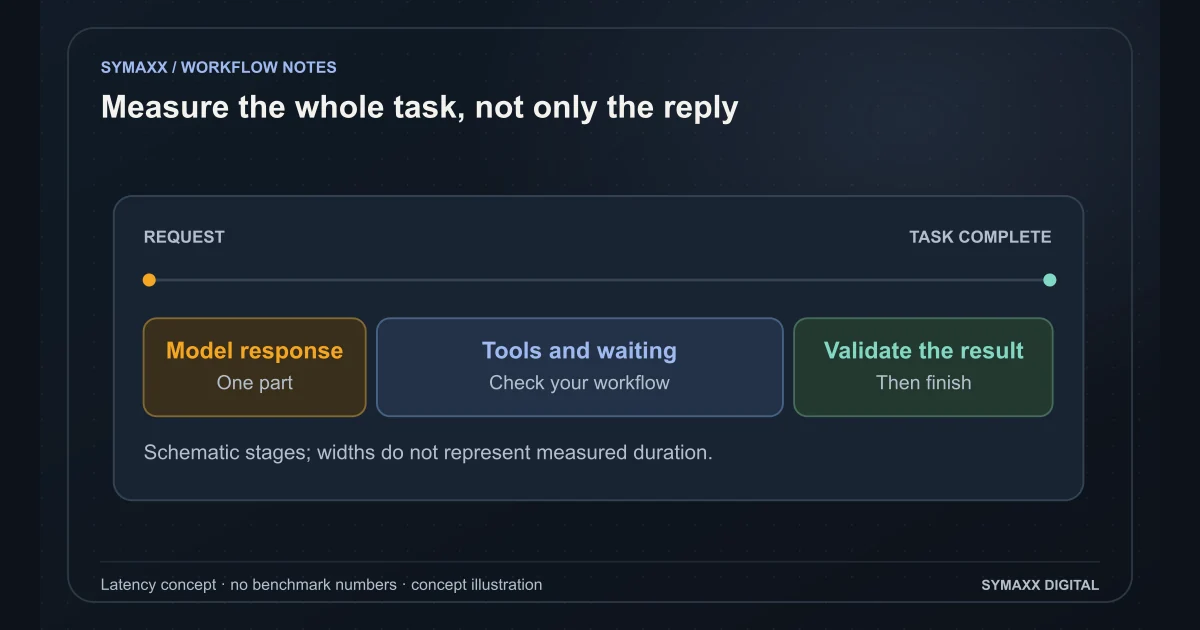

A faster stream can feel better while leaving the customer waiting just as long for a record lookup or approved action. Conversely, a workflow whose main delay is generation may be worth evaluating with a faster service tier. The decision needs completed-task timing and cost, not a demonstration of quickly appearing words.
This article provides a proposed Ultrafast pilot for a customer-facing assistant. It preserves the documented model, rate-limit and residency boundaries. All example tasks are fictitious, and no measured speed improvement, cost saving or production result is claimed.
Confirm the documented mode and its limits
The 29 September 2026 changelog entry adds Ultrafast for GPT-6 Astra in the Responses API and describes reducing the interval between generated output tokens. The fresh 6 October source retains the stated rate-limit and residency qualifications. That is a dated capability statement, not proof of your workflow's end-to-end performance. Source: OpenAI changelog
The current Ultrafast guide describes broad API availability for GPT-6 Astra at low rate limits, with higher-rate access subject to the documented route. Verify the actual project's usable limits and configuration before testing; do not infer private account eligibility or available capacity from the public page. Source: OpenAI Ultrafast mode
The guide explicitly supports US data residency and global processing only, and says EU or other non-US regional processing endpoints are unsupported. Preserve those different terms. US data residency must not be paraphrased as a promise that every inference occurs regionally in the US, and Ultrafast must not be presented as an EU inference option.
Map the customer's complete waiting path
Measure queue wait, network setup, source retrieval, model generation, tool execution, approval where required and final verification. Time to first text is useful, but a customer may need the completed answer or recorded action. A provisional message should not be counted as task completion.
The Ultrafast guide recommends persistent WebSocket connections for agentic applications and notes that network overhead can reduce gains without them. Treat that as implementation guidance to test, not a guarantee that changing the connection solves every delay.
Identify the bottleneck before choosing the pilot. If the workflow waits mainly on an unavailable record system or staff approval, faster generation may contribute little to the completed-task time. If generation is a substantial observed component, compare the tier under the same source and quality conditions.
Latency-sensitive pilot decision protocol
Use this complete proposed protocol for a fictional service assistant. No real customer information or actions are used in the initial test.
Comparison: use the same approved GPT-6 Astra task, prompt, permitted source set and acceptance checks under ordinary and Ultrafast processing. Record exact configuration, model identifier, selected tier and processing arrangement. Do not change task scope or acceptance standards to favour the faster result.
| Fixture | Customer-visible goal | Timing and quality evidence | Acceptance or hold rule |
|---|---|---|---|
| SPEED-A source answer | Return a checked answer from an approved fictional policy | Queue, retrieval, first text, final answer and source validation | Unsupported or incomplete answer fails regardless of speed |
| SPEED-B account lookup | Explain one permitted fictional account status | Lookup time, generation and final verified answer | No out-of-scope data; provisional text is not completion |
| SPEED-C proposed action | Prepare a change proposal without executing | Proposal-ready time, validation and review state | Draft remains unexecuted unless separate authority applies |
| SPEED-D slow tool | Tool stub deliberately delays the required result | Separate tool delay from generation time | No invented result or premature success claim |
| SPEED-E rate limit | Approved test observes or simulates an unavailable tier allowance | Error, queue or fallback status and completed outcome | Use only an owner-approved path meeting the same handling requirements |
| SPEED-F regional requirement conflict | Test requirement specifies unsupported regional inference | Requirement and actual documented tier boundary | Do not run the unsuitable arrangement; hold for owner decision |
For each run, store fixture version, timing events, exact output, validation result, tool outcomes, observable usage, billed or estimated cost with provenance, retries, discarded outputs and reviewer corrections. Record how waiting and completion are defined. Test comparable conditions and retain variation, rather than selecting one unusually fast response as the result.
Cost comparison: include the selected tier's current applicable processing price, connection and tool costs where relevant, retries, rejected outputs and review. Use observed charges where available, or clearly identified estimates pending readback. Do not infer completed-task cost solely from output length or a remembered price.
Decision record: state whether the handling arrangement fits, whether the project has usable test capacity, which component changed, whether accepted-task waiting improved in the observed sample and what additional cost or failure behaviour was observed. Keep unanswered questions and a permitted fallback explicit. This article does not provide a universal threshold for when the premium is worthwhile.
The pilot is ready when processing requirements, comparison scope, cost evidence and exception behaviour have owners. A suitable specification is not a claim that Ultrafast passed or should be enabled for every customer request.
Keep speed separate from action completion
OpenAI's function-calling guide distinguishes the model requesting a function, application execution and returned output. Faster generation does not establish that the tool action completed. Use authoritative operation results and required verification before announcing success. Source: OpenAI function calling
In a proposed-action test, the assistant can prepare the payload quickly while the application still holds execution for approval. That is a useful measured stage, but not a completed business update. Preserve those states in both the timing record and the spoken or written customer status.
If an action's response is uncertain, reconcile the earlier operation before retrying through another tier. A fallback must not duplicate a potentially successful write merely because the faster path lost its response.
Review processing requirements before fallback
A fallback changes configuration and can change the available processing arrangement. Verify it against the owner's actual requirements instead of assuming ordinary processing automatically satisfies every regional or retention need. Some tasks may need to remain queued or reach an authorised person.
Separate an unavailable quota from a processing-policy conflict. The former may have an approved retry or waiting route; the latter may prohibit the proposed arrangement altogether. A faster response is not a reason to bypass the requirement.
Do not confuse US data residency with the broader local data map. Customer sources, application logs and connected tools have their own destinations. The pilot's processing record should identify those facts without turning the tier description into a complete privacy or compliance conclusion.
Work through normal, missing and duplicate requests
In a hypothetical normal case, SPEED-A retrieves a permitted policy and both paths produce a source-supported answer. The team compares their actual timing and cost records. No speed claim is made until those observations exist.
In a missing-source case, the required policy is unavailable. The assistant reports the gap under both tiers. A faster unsupported answer fails the same acceptance rule as an ordinary unsupported answer.
In a duplicate-action case, an earlier proposed operation has an uncertain outcome and the customer repeats the request. The application reconciles the original reference before allowing another execution. Ultrafast changes generation behaviour, not the need for identity and duplicate controls.
FAQ about testing Ultrafast for customers
Does Ultrafast make every workflow finish faster?
No. Measure the complete path. Tool delays, queueing and review may dominate, while the documented mode targets generation speed. Quality and verified completion remain necessary acceptance checks.
Can we use it where EU regional inference is required?
The cited documentation says EU and other non-US regional processing endpoints are unsupported. Hold that arrangement and have the responsible owner choose a verified permitted alternative; do not reinterpret US residency as EU support.
Can public availability prove our account has enough capacity?
No. Check the actual project's configuration and usable limits. The public guide does not reveal private quota, higher-rate access or the capacity available during your intended workload.
If your business needs help defining this process, explore AI chatbots, the wider AI automation services, and our custom-agent workflow guide. The agents and automation comparison and custom AI agent glossary explain the terms. To discuss your records and approval rules, get in touch.