
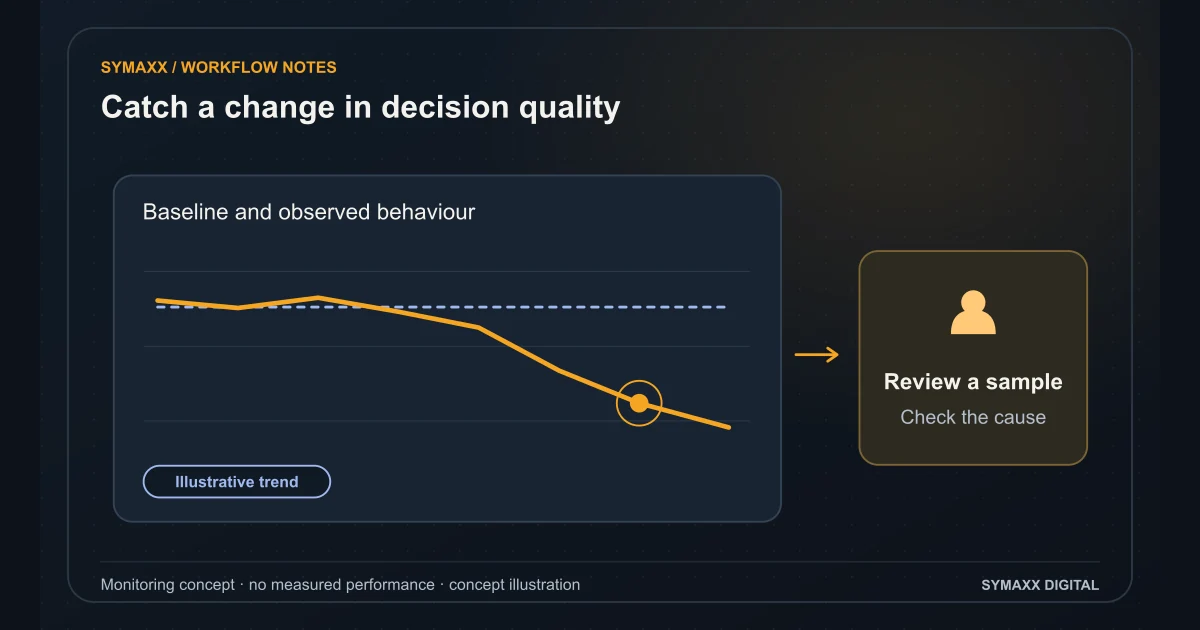

Create a versioned baseline before deployment, then monitor business outcomes, task success, unsafe actions, overrides, escalations and representative human-reviewed samples. Segment by input type, customer group, tool and version so an overall average cannot hide a failing cohort.
This is an AI operations and analytics problem. Quiet degradation can come from model, prompt, retrieval, tool, source-data, customer-behaviour or policy change even when uptime remains green.
NIST's 2026 monitoring report explains why deployment creates monitoring challenges that pre-release testing cannot fully resolve Source: NIST.
Define the decision boundary
List what the agent may decide, recommend and execute. Rate each task by customer, financial, legal, safety and operational consequence.
Higher-risk actions need tighter review, richer traces and faster stop controls. Do not use one monitoring standard for FAQ drafting and account cancellation.
Create a monitoring sheet with the decision, expected outcome, trace location, reviewer, alert threshold and recovery owner. Our custom AI agents guide gives context for the workflow being monitored.
Establish a pre-deployment baseline
Build a representative evaluation set with ordinary, difficult, rare, adversarial and prohibited cases. Record expected outcomes, acceptable alternatives and failure severity.
Run the exact production configuration and preserve model, prompt, tool, retrieval and policy versions. Include latency and cost.
The baseline should reflect real work, not only examples the agent was designed around.
Define outcome metrics
Measure whether the business task completed correctly and safely. Useful measures can include first-pass success, verified accuracy, resolution, rework, recovery, customer complaint and downstream value.
Avoid relying on model confidence, token count or user thumbs-up alone. Those can support diagnosis without proving correctness.
The custom AI agent glossary defines the system being evaluated. Keep offline benchmark results separate from live customer outcomes in your review.
Monitor operational behaviour
Track latency percentiles, timeouts, tool failures, retries, loop length, token and external-service cost, queue depth and completion. A slower dependency can cause the agent to choose weaker fallbacks.
Alert on distribution changes, not just total failures. A rise in five-tool loops may precede visible customer harm.
Connect operational traces to the outcome record.
Sample decisions for human review
Review random cases plus risk-based samples: low confidence, unusual tool paths, overrides, complaints, policy boundaries and new input clusters. Use a clear rubric and trained reviewers.
Measure agreement between reviewers and resolve ambiguous criteria. Protect personal information in review tools.
NIST describes post-deployment monitoring as important for unforeseen outputs and dynamic real-world conditions Source: NIST.
Segment the metrics
Break results down by task, language, customer profile, product, channel, time, input length, tool, model and release. Choose segments relevant to risk and fairness.
In a hypothetical example, an overall 95% success rate could hide a smaller new customer group at 60%. These figures illustrate the problem; they are not Symaxx results. Show sample sizes and uncertainty.
Investigate newly growing “other” categories.
Watch input and output drift
Compare current input topics, formats, lengths, languages and source distributions with the baseline. Track output refusal, escalation, action and error patterns.
Drift does not automatically mean quality fell. It signals that old evaluations may no longer represent live work.
Add new verified cases to the test set without rewriting history.
Audit tool selection and arguments
Record which tool the agent called, validated arguments, authorisation decision, result and final use. Monitor unexpected tools, denied requests, high-risk sequences and duplicate actions.
Validate business rules outside the model. A fluent explanation must not override a failed permission check.
For each consequential tool call, record the permission, input validation, action, confirmation and recovery path. Our AI CRM integration guide discusses a common integration context; the action log must still reflect your actual implementation.
Monitor retrieval quality
Track source freshness, coverage, permission, relevance and citation. Detect missing or changed documents and index failures.
Compare answers against authoritative records in samples. A stable model can degrade when the knowledge source becomes stale or the retrieval filter changes.
Version the index and preserve source identifiers.
Capture overrides and escalations
Record when users reject, correct, retry or escalate an agent output and why. Distinguish healthy human control from repeated agent failure.
Do not punish staff for using a safety control. Encourage reports of near misses and confusing behaviour.
Analyse corrections as candidate evaluation cases.
Monitor security and misuse
Track prompt-injection attempts, permission denials, abnormal data access, tool abuse, extraction patterns and policy evasion. Coordinate with security incident response.
Redact secrets and sensitive payloads from logs. Restrict trace access and retention.
Test adversarial cases after any capability expansion.
Control changes
Treat model, prompt, system message, retrieval, tool schema, policy and workflow changes as releases. Run offline evaluations and contract tests before production.
Use canary traffic or shadow comparison for material changes. Keep one variable stable where possible so causes remain interpretable.
Document approval, release time and rollback version.
Set stop thresholds
Define conditions that disable an action, route to human review, roll back a release or stop the entire agent. Include severe single incidents as well as sustained metric changes.
Thresholds should combine risk, volume and evidence. Avoid waiting for statistical certainty after serious customer harm.
Test the kill switch and degraded-mode workflow.
Investigate with complete traces
Preserve a privacy-minimised trace of input class, versions, retrieved source IDs, tool decisions, outputs, policy checks and human action. Use correlation IDs across services.
Reconstruct the case without storing more raw data than the purpose justifies. Retention and access belong in the monitoring design.
Create incident severity and root-cause categories.
My take: monitoring starts with a rollback promise
My take is that a team does not truly monitor an agent if it cannot safely change what happens when an alert fires. Dashboards without decision owners and rollback controls are observation, not operations.
Every important signal needs a named action and response time.
Review the monitor itself
Audit missing logs, sampling bias, stale thresholds, reviewer drift and undetected segments. Compare monitoring with complaints, support, audits and independent evaluations.
NIST notes that monitoring methods and terminology remain developing and that real-world oversight has practical barriers Source: NIST. Keep the system open to improvement.
Review risk and cadence as agent autonomy changes.
Calibrate reviewers and rubrics
Give several reviewers the same sample and compare their ratings and reasons. Resolve unclear criteria, add boundary examples and separate factual error, policy violation, weak style and acceptable variation.
Recalibrate periodically because reviewers learn, policies change and live cases become harder. Preserve the original rating as well as any adjudicated result.
Test for silent policy regression
Maintain cases where the correct behaviour is refusal, escalation, clarification or no action. Track whether the agent becomes more willing to complete prohibited or ambiguous tasks after a prompt or model update.
Measure false refusals too. Safety that blocks legitimate work can quietly reduce value and drive employees to unmonitored workarounds.
Frequently asked questions
Is model drift the only cause of degradation?
No. Prompts, tools, retrieval, source data, users, policies and dependencies can change while the model remains identical.
How much production traffic should humans review?
Use a risk-based mix of random and targeted samples. The right rate depends on consequence, volume, evidence quality and automation maturity.
Can user ratings detect quality decline?
They help, but response bias and unobserved errors limit them. Combine ratings with outcomes, traces and expert review.
When should an agent be rolled back?
Use pre-agreed severe-incident and sustained-degradation thresholds, with authority assigned before launch.
Make degradation visible before customers teach you
If your business needs an agent evaluation and monitoring system, get in touch for AI automation.