


What Is Keyword Research?
Keyword research is the process of finding and analysing the search terms people type into Google when they are looking for products, services, or information related to your business.
It answers the most fundamental question in SEO: what are your potential customers actually searching for?
Without keyword research, every SEO effort is built on assumptions.
You might optimise for terms nobody searches, target keywords that are too competitive, or miss opportunities where demand exists and competition is still manageable.
Keyword research turns guesswork into a data-driven strategy. It helps you decide which pages to create, what topics to write about, and which queries to prioritise first.
Why Keywords Still Matter in 2026
Google's algorithm has evolved far beyond simple keyword matching.
It uses natural language processing (NLP) to understand topics, synonyms, and searcher intent. Some people take that to mean keyword research no longer matters. It still does.
Keywords still matter because:
- They reveal demand. Volume data tells you whether anyone is searching for what you offer.
- They reveal intent. The phrasing tells you where the searcher is in their buying journey.
- They reveal competition. Difficulty scores tell you whether ranking is realistic.
- They structure your content. Topic clusters need primary keywords to organise around.
What's changed is how you use keywords. Rather than targeting exact-match phrases repeatedly, you target topics and cover them properly. Google understands that "SEO costs south africa," "how much does SEO cost in SA," and "SEO pricing ZAR" are the same topic, so one page can rank for all of them.
Step 1: Seed Keywords from Your Business
Start with what you know. List your core products, services, and the problems you solve:
| Your Business | Seed Keywords |
|---|---|
| Web design agency in Pretoria | web design, website development, web design pretoria |
| Accounting firm | accountant, tax services, bookkeeping, audit |
| Online clothing store | buy clothes online, fashion south africa, women's dresses |
| Plumber in Cape Town | plumber, plumbing services, plumber cape town |
Expand with variations:
- What do customers call your service? Some say "web design," others say "website development".
- What problems do you solve? For example, "my website is slow" or "need more leads online".
- What questions do clients ask? For example, "how much does a website cost" or "do I need SEO".
Tip: Check your Google Search Console. The "Queries" report shows exactly what terms people already use to find your site - many will surprise you.
If your business is reviewing keyword research for seo, I would use this article as a practical pause point: check the current page, compare it with the real buyer question, and then decide whether the next move belongs in content, content marketing, or a clearer conversion path.
Step 2: Expand with Keyword Tools
Use tools to expand your seed list into hundreds of relevant variations.
Free Tools
| Tool | Best For | Limitations |
|---|---|---|
| Google Keyword Planner | Volume estimates, basic suggestions | Designed for ads; ranges not exact volumes |
| Ubersuggest | Keyword ideas, difficulty scores | Limited free queries per day |
| AnswerThePublic | Question-based keywords | Limited free searches |
| Google Autocomplete | Long-tail suggestions | No volume data |
| Google "People Also Ask" | Related questions | Manual extraction |
Paid Tools
| Tool | Monthly Cost | Best For |
|---|---|---|
| Ahrefs | ~$99/month | Very large keyword database |
| SEMrush | ~$129/month | Competitor keyword analysis |
| Moz Pro | ~$99/month | Keyword difficulty scoring |
Expansion Techniques
Modifier stacking: Add prefixes and suffixes to seed keywords:
- "top [keyword]"
- "[keyword] near me"
- "[keyword] south africa"
- "how to [keyword]"
- "[keyword] cost" or "[keyword] price"
- "[keyword] for [industry]"
Competitor mining: Enter competitor URLs into Ubersuggest or Ahrefs to see which keywords they rank for. This reveals opportunities you've missed.
People Also Ask: Search your seed keywords on Google and expand the "People Also Ask" section. These are directly from Google's understanding of related queries.
Practical Example: Cleaning a Ubersuggest Export
For a South African service business, the raw export is rarely the strategy.
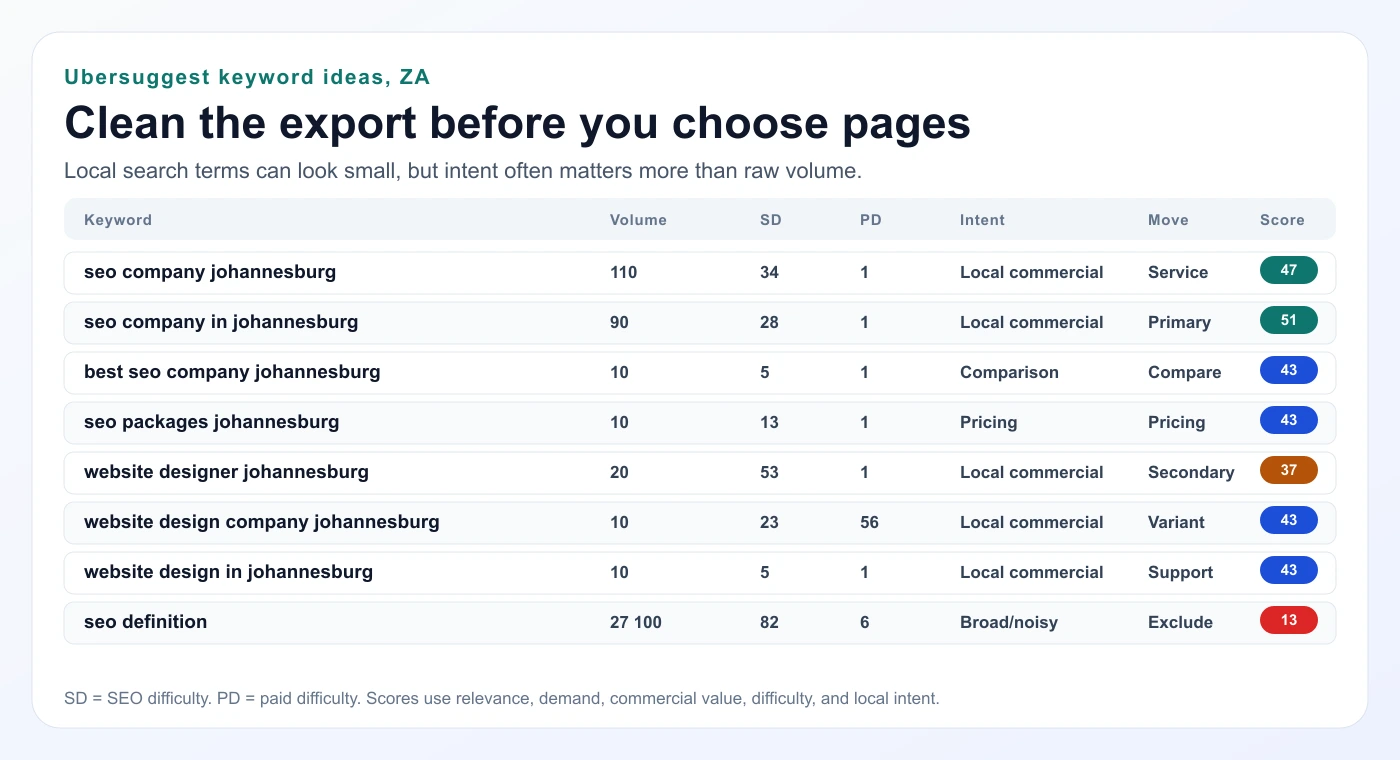
In a Ubersuggest keyword ideas pull for local SEO and website design terms in South Africa, the export included a mix of useful local commercial terms and noisy broad terms. That is normal. A tool gives you data. Your job is to decide what deserves a page, what deserves a supporting section, and what should be ignored.
The important lesson is visible in the data:
seo company in johannesburghad lower volume than broad SEO terms, but the intent was much more commercial.- The comparison-focused Johannesburg SEO term had small volume, but it is a useful support topic.
seo packages johannesburgis a pricing-intent term, so it belongs near pricing content or a commercial FAQ.seo definitionhad far higher volume, but it is too broad for a local lead-generation campaign.
That is why I do not recommend exporting 200 keywords and simply writing articles for the biggest numbers. First remove irrelevant geographies, job queries, beginner definitions, and terms where the intent does not match the business model. Then score what is left.
Step 3: Analyse Volume, Difficulty, and Intent
Not all keywords are worth pursuing. Filter and prioritise using three metrics: Our deeper search volume and keyword difficulty guide is useful if you want the fuller methodology behind these trade-offs.
Search Volume
Monthly search volume indicates demand. For SA keywords:
| Volume | Classification | Typical Use |
|---|---|---|
| 10,000+ | Very high | Broad terms - often very competitive |
| 1,000-10,000 | High | Core service keywords |
| 100-1,000 | Medium | Specific service + location keywords |
| 10-100 | Low | Long-tail, niche keywords |
Don't dismiss low-volume keywords. "SEO for dentists pretoria" may only get 50 searches/month, but every searcher is a potential high-value client.
Keyword Difficulty
Difficulty scores (typically 0-100) estimate how hard it is to rank on page one. For a new or small website:
| Difficulty | Realistic? | Strategy |
|---|---|---|
| 0-20 | Yes - quick wins | Target immediately |
| 20-40 | Yes - with effort | Target with quality content + basic link building |
| 40-60 | Challenging | Requires strong content + dedicated link building |
| 60-80 | Difficult | Need significant authority first |
| 80-100 | Very difficult | Enterprise-level only |
Search Intent
Intent categorisation determines what type of content to create:
| Intent | Signal Words | Content Type |
|---|---|---|
| Informational | "what is," "how to," "guide," "tips" | Blog posts, guides |
| Commercial investigation | "best," "vs," "review," "comparison" | Comparison pages, reviews |
| Transactional | "buy," "price," "hire," "near me" | Service/product pages |
| Navigational | "[brand name]," "[specific site]" | Homepage, brand pages |
Critical rule: Match content type to intent. A blog post cannot rank for a transactional keyword. A product page cannot rank for an informational keyword. Google matches content format to intent.
Keyword Prioritisation Scoring Matrix
Use this framework to score and rank keywords before assigning them to pages:
| Factor | Weight | Score 1 (Low) | Score 3 (Medium) | Score 5 (High) |
|---|---|---|---|---|
| Relevance | 3× | Loosely related to your services | Related but not core | Directly describes what you sell |
| Search volume | 2x | Under 50/month | 50-500/month | 500+/month |
| Commercial value | 3x | Informational only | Commercial investigation | Ready-to-buy transactional |
| Difficulty | 2x | 60+ (very hard) | 30-60 (moderate) | Under 30 (achievable) |
| Local opportunity | 1x | No local angle | City-modified versions exist | Strong local intent with low competition |
How to use: Score each keyword across all 5 factors, multiply by weight, and total. Keywords scoring 40+ are high-priority targets. This prevents chasing high-volume keywords that are either irrelevant or impossibly competitive.
A good scoring matrix should lead to a page decision:
| Keyword | Best Page Decision | Why |
|---|---|---|
| seo company in johannesburg | Build or strengthen a local service page | Commercial + local intent |
| seo company johannesburg | Cluster with the main service page | Same buyer journey, similar intent |
| comparison-focused Johannesburg SEO term | Create supporting comparison content | Commercial investigation intent |
| seo packages johannesburg | Add pricing content or FAQ support | Pricing intent |
| seo definition | Exclude from this local campaign | Too broad for lead generation |
This is the part many keyword lists miss. The final output should not be "keywords we found." It should be "pages we need, sections we need, and keywords we are deliberately ignoring."
Step 4: Group into Topic Clusters
Individual keywords are not your strategy unit - topic clusters are.
A topic cluster consists of:
- Pillar page: The main page targeting the broad topic
- Supporting pages: Blog posts and guides targeting specific subtopics
- Internal links: Connections between all pages in the cluster
Example: SEO Topic Cluster
Pillar: /seo (targets "seo services," "seo south africa")
├── /blog/what-is-seo (targets "what is seo")
├── /blog/seo-costs-south-africa (targets "seo cost")
├── /blog/technical-seo-checklist (targets "technical seo")
├── /blog/local-seo-guide (targets "local seo")
├── /seo/technical-seo (sub-service page)
├── /seo/local-seo (sub-service page)
└── /seo/pricing (commercial intent)
Each page in the cluster reinforces the others. Internal links between them signal to Google that your site has deep expertise on the topic, building topical authority that makes every page in the cluster rank better.
Step 5: Map Keywords to Pages
Every keyword group should be assigned to a specific page - either existing or planned.
The Mapping Framework
| Primary Keyword | Secondary Keywords | Assigned Page | Status |
|---|---|---|---|
| seo services pretoria | seo agency pretoria, seo company pretoria | /seo/pretoria | Existing |
| what is seo | seo meaning, how seo works | /blog/what-is-seo | New |
| seo pricing south africa | seo cost, seo packages | /seo/pricing | Existing |
Rules:
- One primary keyword per page. Avoid targeting the same primary keyword on two pages if you want to avoid keyword cannibalisation.
- Multiple secondary keywords per page. Three to eight related terms is usually enough.
- If no existing page fits, plan a new one.
- If two existing pages target the same keyword, consolidate.
SA-Specific Keyword Research Tips
South African search behaviour has patterns that differ from US or UK markets:
City modifiers are essential
SA searches frequently include city names. The same service keyword can have very different demand and competition across cities:
| Keyword Pattern | Example | Why It Matters |
|---|---|---|
| [service] [city] | "plumber pretoria" | Different demand and competition per city |
| [service] near me | "dentist near me" | Growing rapidly since 2022; mobile-dominant |
| [service] [suburb] | "accountant sandton" | Lower volume but very high intent |
| best [service] [city] | "best web designer cape town" | Commercial investigation intent |
| [service] cost [city] | "website design cost johannesburg" | Pricing intent with local context |
Language considerations
South Africa has 11 official languages. Most commercial searches happen in English, but Afrikaans keywords can reveal untapped niches, especially in the Western Cape and Free State.
SA-specific search patterns
| Pattern | Implication for Keyword Research |
|---|---|
| Mobile-first (over 70% of SA web traffic) | Prioritise shorter, voice-friendly keyword variations |
| "Near me" growth | Include proximity-based keywords in local campaigns |
| Pricing queries include "ZAR" or "rand" | Add currency modifiers to pricing keyword lists |
| Trust queries ("is [company] legit") | Consider creating trust-building content targeting these queries |
| Load shedding-related searches | Seasonal; can affect search volume patterns |
For more on how keyword research feeds into broader SEO campaigns, our SEO resource documentation covers strategy frameworks in detail.
If you want a clearer plan for keyword research for seo, get in touch or book a strategy call. I can review the current page, the search intent behind it, and the most useful next step across content marketing, content, and conversion.
FAQs
How many keywords should I target per page?
One primary keyword and 3-8 secondary keywords. Each page should have a clear primary topic. Google naturally ranks pages for related variations of the primary keyword.
How often should I do keyword research?
Full keyword research at the start of your SEO campaign, then quarterly reviews to identify new opportunities and shifting trends. Monitor Google Search Console monthly for emerging queries.
What's a strong free keyword research tool?
Google Keyword Planner for volume estimates and Ubersuggest for keyword ideas and difficulty scores. Combined with Google Search Console data, these cover most needs without cost. If you want a broader technical baseline alongside keyword work, browse our free SEO tools.
Should I target high-volume or low-volume keywords?
Both, strategically. Target low-volume, low-difficulty keywords first for quick wins. Simultaneously build authority to compete for higher-volume keywords over time. This is the approach that compounds fastest. See our SEO pricing page for how keyword targeting strategy factors into campaign scope.
How do I know if a keyword is too competitive?
Check the top-ranking pages. If they're all high-authority domains (Wikipedia, government sites, major publications) with thousands of backlinks, the keyword is likely too competitive for a newer site. Target longer-tail variations instead.
What's the difference between short-tail and long-tail keywords?
Short-tail: broad, high volume, high competition ("seo"). Long-tail: specific, lower volume, lower competition ("seo for small business south africa"). Long-tail keywords convert better because they indicate more specific intent. See our guide on SEO for small businesses for practical application.
Conclusion
Keyword research is not a one-time task - it's the ongoing intelligence system that drives your entire SEO strategy. Every page you create, every piece of content you publish, and every optimisation you make should be informed by keyword data.
Start with Step 1 today. List your seed keywords, run them through a free tool, and you'll discover dozens of opportunities you didn't know existed. The businesses that rank on page one are the ones that let data - not intuition - guide their content decisions.